If your climate chamber is not working, check the pump
This week I wanted to start an experiment in a brand-new Memmert HCP 105 climate chamber. However, the chamber did not increase the humidity although the water reservoir was full and the settings were correct. The troubleshooting section in the handbook was not very helpful and a quick call to the support hotline did not yield an easy fix. Not wanting to have a technician come out only to find out that the problem was something simple, I decided to open up the back panel and check the issue myself.
A climate chamber is basically a box with a heater and a humidifier. Some models also have a cooling system, but the HCP series does not [*]. The humidifier works by pumping water from the reservoir to a heating element, which then evaporates the water and increases the humidity in the chamber. Depending on the model the internal pipework can be quite complex, including several pumps and valves and so on. In the case of the HCP 105 there is just one pump. It's a swiss-made KNF diaphragm pump. The manufacturer advertises it as "dry-running" (can confirm that), "self-priming" (not so sure about that one) and "maintenance-free" (only time will tell). The pump is located at the back of the chamber and is easily accessible by removing the back panel. It is connected to the water reservoir via a tube and a filter.
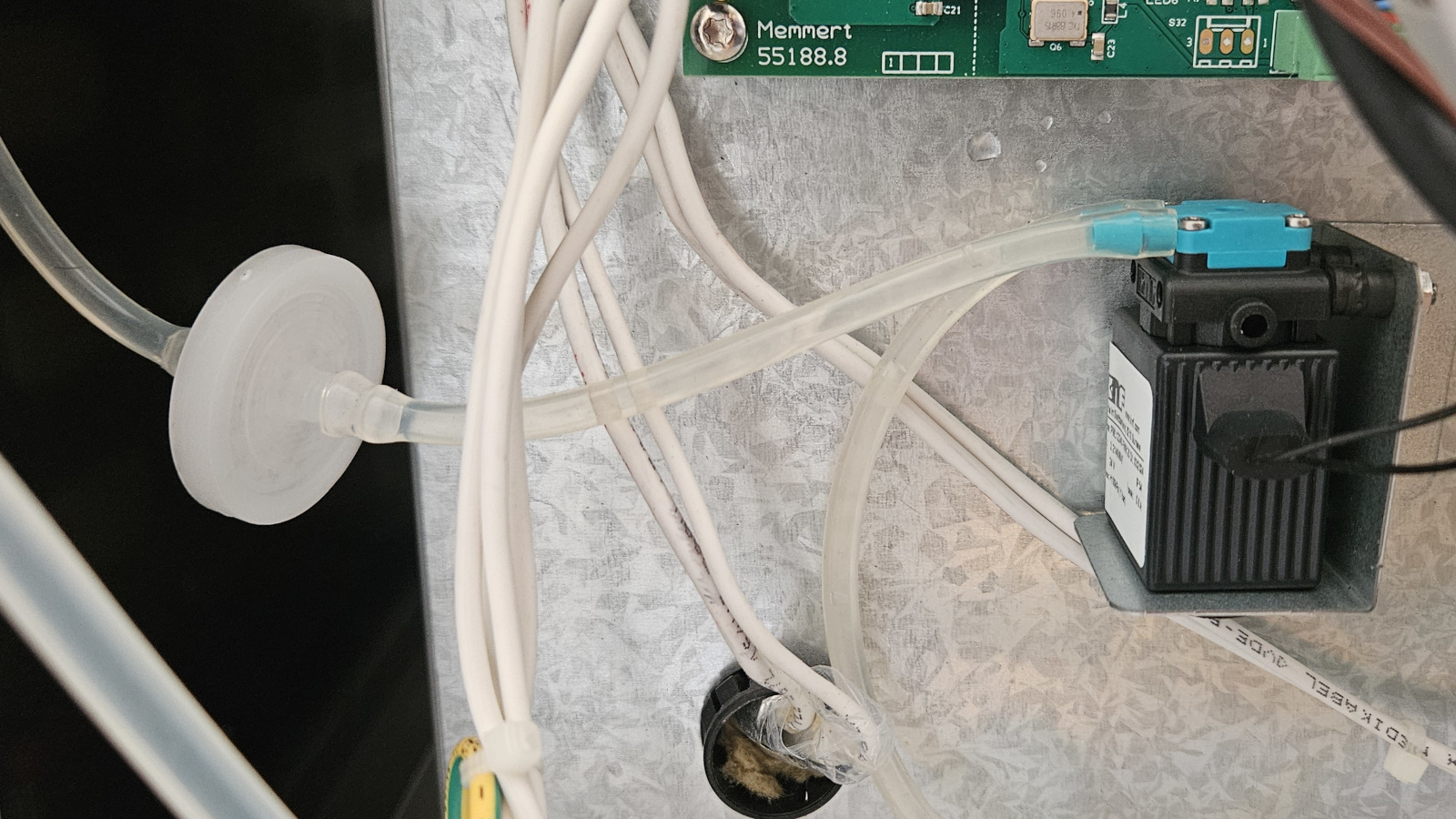
Internals of the chamber after opening the back panel.Inlet filter on the left and diaphragm pump on the right. The tube curving downward from the pump leads to the heating element of the humidifier.
Connecting the tank showed that no water was being sucked into the chamber inlet port. So the pump was not working. However, every time the chamber's electronics energized the pump's coil a clicking sound could be heard. After some fuzzing around the successful fix was as follows. 1. Turn off the chamber and unplug it. 2. Have some paper towel ready! 3. Disconnect the water supply tube from the inlet port on the back side of the chamber. 4. Open the back panel by releasing the three screws on the lower side of the panel (Torx T15). 5. Disconnecting the inlet tube from the pump. This is a friction fit, so just jank it hard enough. 6. Now the tricky part. Connect the water supply to the port let water run through the pump inlet tube until all air has been pushed out. Now, while the water is running, connect the inlet tube to the pump. Catch the spillover with the paper towel. This will make sure that water reaches right up to the pump's input valve.
Now the pump should be working again (at least it did in my case :smile:).
This happened with two chambers that sat around unused for many months after purchase. I guess the pump's diaphragm got stuck to the valve and dried out. I have had a similar issue in the past with a pump in an Espec Platinous series chamber, so it seems to be a common issue.
| [*] | Not having a cooling system is certainly a limitation for some applications, but it makes the device so much simpler and basically maintenance free. Service costs for these device can be quite substantial, so that is an important consideration when choosing a climate chamber. |